action asymmetry hypothesis
There is a well-documented phenomenon in perception: lower frequency information is processed faster in the right hemisphere, and higher frequency information is processed faster in the left hemisphere. This is true in both vision and audition.
Why? The action asymmetry hypothesis proposes that this comes from hand dominance. Your dominant hand performs fine motor actions (writing, threading a needle), which require high spatial frequency processing. Your non-dominant hand performs coarse motor actions (stabilizing, holding), which require low spatial frequency processing.
Because most people are right-handed, and motor cortex is contralateral (right hand controlled by left hemisphere), this would cause left hemisphere specialization for high frequencies and right hemisphere specialization for low frequencies.
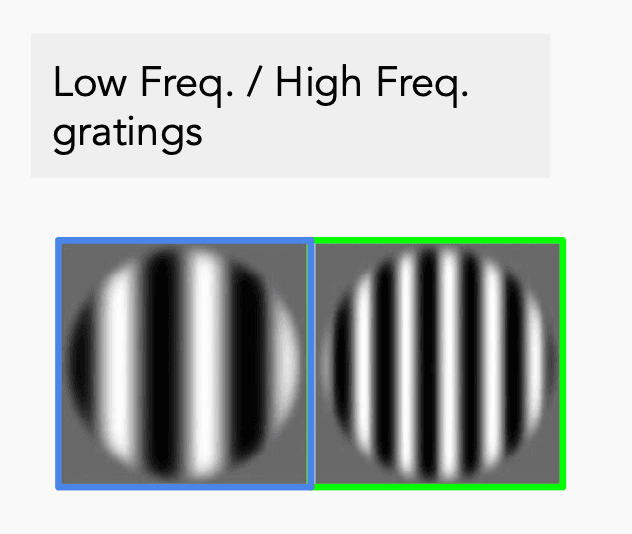
Fig. 1: Spatial frequency gratings. Low frequency (left) has wider bars, high frequency (right) has narrower bars. The brain processes these differently depending on which hemisphere receives the information.
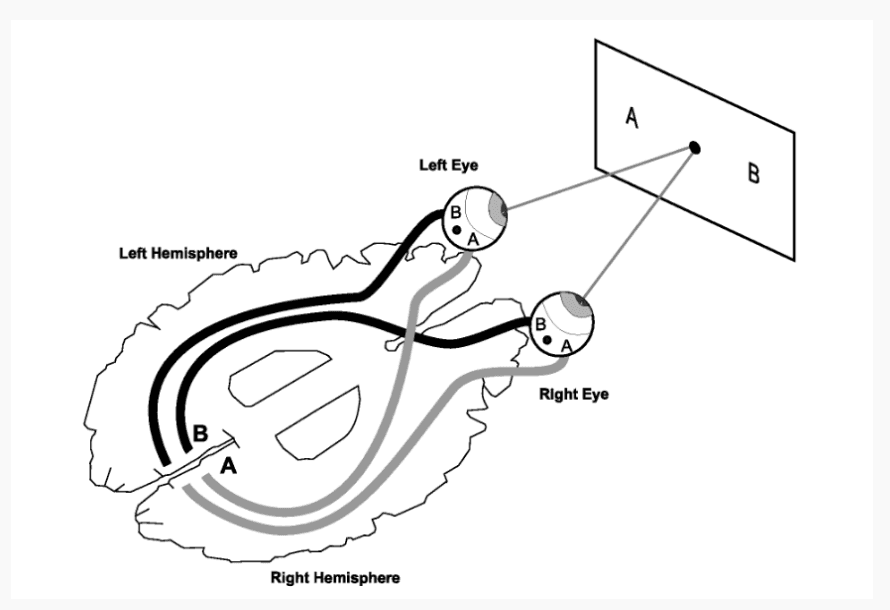
Fig. 2: The visual pathway is contralateral. Information from the left visual field (B) goes to the right hemisphere, and information from the right visual field (A) goes to the left hemisphere. This crossing happens at the optic chiasm.
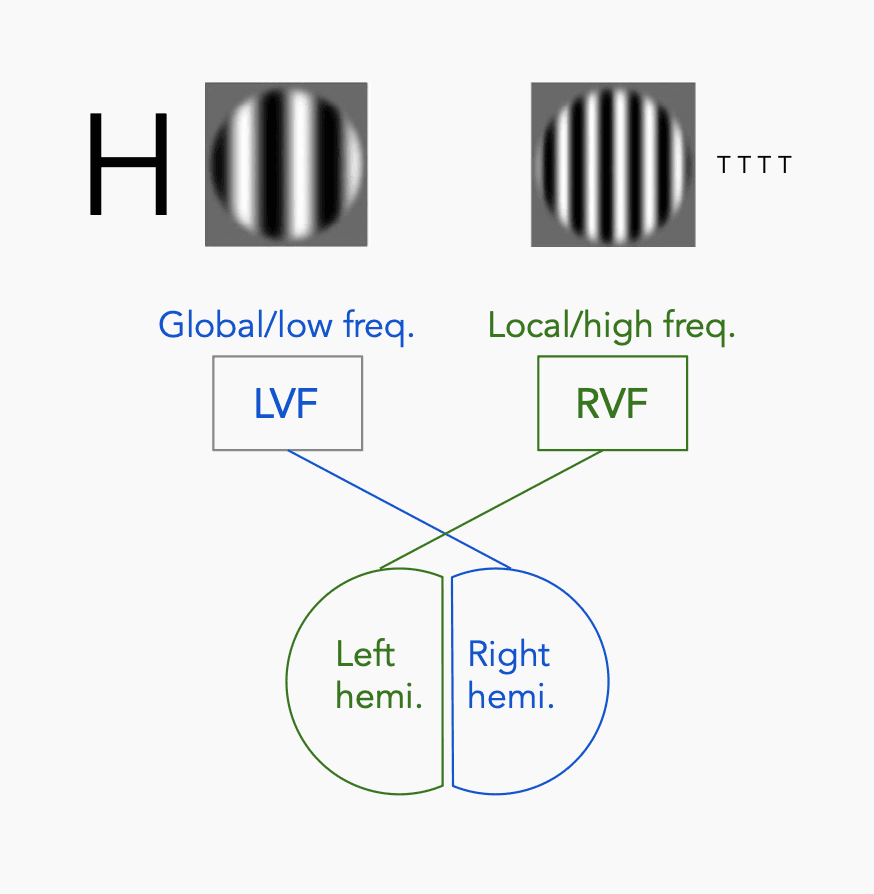
Fig. 3: The complete model. Global/low frequency information in the left visual field (LVF) is processed by the right hemisphere. Local/high frequency information in the right visual field (RVF) is processed by the left hemisphere. The H made of Ts illustrates global vs local processing.
research questions
Do right and left handers have systematically different frequency information in their left and right visual hemifields, as measured in egocentric video?
Do right handers have more high-frequency information in the right visual field, and left handers more high-frequency information in the left?
hypotheses
methods
what i did
I worked with egocentric eye gaze data, processing video recordings to extract gaze coordinates. Using Fourier transforms, I plotted out sections of high and low spatial frequency power across the left and right visual hemifields. This allowed us to quantify whether there were systematic differences in frequency content based on handedness.